




1. Common dispensing problems
The common problem of dispensing is that the valve glue nozzle drop glue, hanging glue, loose glue, bubbles, the size of the glue is inconsistent this kind of bad glue. In the product will reflect the residual glue, deviation, the package is not strict. Glue quality, glue out process, temperature, viscosity, air pressure, back pressure, needle configuration, etc., will affect the quality of the glue out. For the adjustment of the above parameters, should be from the point and the surface of the way, the change of any parameter will affect other aspects. At the same time, the emergence of defects may be caused by multiple aspects, and possible factors should be checked one by item and then eliminated. In short, the production parameters should be adjusted according to the actual situation, not only to ensure the production quality, but also to improve the production efficiency.
1.1 Common problems of dispensing products: bubble (take spray valve point UV glue as an example)

One of the more common problems with spray dispensing is easy to produce bubbles. The production of bubbles will affect the glue bonding, fatigue resistance, tensile force, and will also splash on the surrounding devices.
1) Bubble production mechanism
When the needle is lifted, a local vacuum is formed between the needle and the nozzle. When the glue in the glue cavity is not enough to fill the area in a short time, the external air will enter the vacuum area through the nozzle hole, mix with the subsequent filled glue, and be ejected together when the needle falls.

2) Bubble solution method

Reduce the needle stroke as much as possible, reduce the generation of vacuum area (choose reasonable needle and nozzle; applicable split nozzle instead of the integrated nozzle, increase the nozzle slender channel length, even if the air enters, it will only exist in the slender channel, and cannot enter the vacuum area; increase the feed pressure, let the glue quickly fill the vacuum area, reduce the possibility of air entering the vacuum area.
1.2 Effect of back pressure on jet dispensing
Excessive fluid pressure (in the hose) and too short valve opening time are possible to penetrate the air into the liquid, and the solution is to reduce the fluid pressure and use a tapered inclined needle.

1) Too large back pressure is easy to cause glue overflow and excessive glue amount; too small pressure will cause intermittent glue and leakage points, resulting in defects. The pressure should be selected according to the glue of the same quality and the working environment temperature. High ambient temperature will make the viscosity of the glue smaller and the fluidity better. At this time, the back pressure should be lowered to ensure the supply of the glue, and vice versa.
2) The replacement of the larger nozzle can improve the back pressure problem, but the process requirements of the product can not use the large diameter nozzle, so the optimized structure and shape of the nozzle is adopted to improve this problem. The taical oblique needle produces the least back pressure and the best fluid flow.
1.3 The size of the glue is inconsistent
When the size of the glue is inconsistent, the air pressure in the hose is mainly unstable. Please check whether the inner sealing piston in the hose is suspended from the glue. Glue is a paste fluid, the use of white piston often rebound suspended, the industry with a safe piston will be better.

1.4 Glue temperature
All fluid materials have corresponding storage temperature, flow temperature, curing conditions (UV curing / temperature curing, etc.). If the general epoxy resin glue should be stored in the 0~5℃ refrigerator, the use should be taken out 1-2 hours in advance, so that the glue is fully consistent with the working temperature. The use temperature of glue should be 23℃ ~25℃; the ambient temperature has a great influence on the viscosity of glue. If the temperature is too low, the glue point will become smaller and drawing will appear. The ambient temperature difference is 5℃, which will cause 50% dispensing amount change, so the ambient temperature should be controlled, at the same time, the environmental humidity should also be guaranteed, the humidity small glue point is easy to dry, affecting the bonding force.
The valve body can be configured with constant temperature heating, which can effectively adjust the temperature of the glue.

1.5 The viscosity of the glue
The viscosity of the glue directly affects the quality of the spot gum. If the viscosity is large, the glue point will become smaller, even brushed; if the viscosity is small, the glue point will become larger, which may dye the pad. In the process of dispensing, a reasonable back pressure and dispensing speed should be selected for different viscosity of glue.

1.6 Case: glue valve dripping, glue hanging, loose glue (take pneumatic injection valve as an example)

1. The quality of the glue, such as whether the glue is overdue, whether there are residual bubbles (the glue in the glue bucket).
2. Check whether the nozzle has a tip (tip) and the tip (best to see under the microscope). Normally, the nozzle is transparent and the tip is not worn.
3. Check the O-ring and Seal (sealing ring) for wear. Normal is: no wear and tear.
4. Check whether the tip of needle (needle) is worn, please carefully check whether the sealing ring is cracked and worn. Normal is: no wear. If there is wear out of the glue will be insufficient power or unstable power, the glue will produce hanging glue, loose glue and other bad glue phenomenon.
5. Finally, check the Jet body for severe wear and aging.
6. Check whether the solenoid valve is worn and aging for a long time.
7. Set the dispensing parameters of the dispensing valve, such as the collocation of nozzle needle, the size of stroke, the pressure of glue and the temperature of glue.
2. Implementation mode of dispensing- -contact type and non-contact type
Contact point glue
Between the dispensing head, glue and dispensing substrate, the three are connected, highly sensitive to the dispensing head, syringe dispensing / screw valve dispensing / needle dispensing valve dispensing.

Non-contact point glue
They are discharged into the substrate like a bullet by the valve; pneumatic injection valve / piezoelectric injection valve / solenoid injection valve.

2.1 Process selection conditions- -Line width requirements
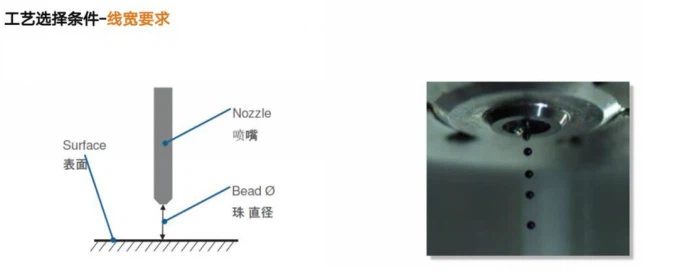
Basically, the minimum point diameter or line width of needle dispensing can be slightly greater than the inner diameter of needle, depending on the distance of the needle head from the substrate (basically equivalent to the inner diameter) and the appropriate movement speed (not too low)
JETTING Because the droplets lose the constraint of the inner wall of the nozzle when flying in the air, the droplets will accumulate larger due to the effect of surface tension. The the minimum point diameter will be greater than twice the nozzle diameter (actually larger)
2.2 Process selection conditions- -flow rate and efficiency

For the contact needle dispensing mode, keeping the height of needle to the substrate unchanged is the key factor to ensure the quality of the dispensing. Without considering the influence of the height difference on the fluid resistance at the needle outlet, that is, when the flow rate and movement speed are constant, we can see that the cross-sectional area of the adhesive strip is nearly equal. When the height of the strip is low, the strip will achieve a larger width; when the strip height is higher, the section is above a certain range (about the outer diameter of the needle).
For some slits, or narrow frames, although the needle method can obtain a smaller line width, the side wall of needle has a thickness, its outer diameter may be greater than the dispensing area, or there is a risk of element collision. At this time, the JETTING method will be more advantageous.
2.3 Process selection conditions- -key parameters
3. Selection of the dispensing needle head
The size of the needle, in the actual work, the inner diameter of the needle should be 1 / 2 of the diameter of the dot glue point, which can not only ensure the quality of the glue point, but also improve the production efficiency.

1. Selection method of dispensing needle, four criteria:
Small dot -- small needle, low pressure, short time
Large point -- large size needle, greater pressure, longer time
Thick glue -- inclined needle, large pressure, set the time as required
Water-based liquid -- small needle, small pressure, set time as required
2. Fluids requiring special settings:
(1) Instant glue: safe piston and Teflon lining metal needle are used for water-based instant glue; for thick instant glue, conical inclined needle is used, if flexibility is needed, PP needle is used.
(2) UV glue: use amber syringe, white piston and diagonal needle (can cover ultraviolet light).
(3) Light curing glue: the use of black opaque syringe, white piston, can cover the ultraviolet needle.
(4) Sealant and paste fluid: if the use of white piston rebound is serious, please use a safe live type, use an inclined needle.